
Coaching
Overview
Coaching in a business environment is a training method in which a more experienced or skilled individual provides an employee with advice and guidance intended to help develop the individual's skills, performance and career. Coaching is distinguished from similar HR competencies of mentoring and counseling (as a step in a progressive discipline system). Coaching may be one of the means used for management development, but it is broader in application than just management training.
Definition
The hallmarks of coaching are that it is personalized and customized and that it is usually done one-on-one and over a period of time, and with a specific business objective in mind. Coaching is similar to, but distinct from, mentoring. The latter is a career development method whereby less experienced employees are matched with more experienced colleagues for guidance either through formal or informal programs. Coaching is frequently used to assist individuals as they prepare for or move into new assignments, improve work habits, adapt to a changing environment or overcome specific obstacles.
Choose your area of interest below to read more
I DON'T KNOW WHAT I DON'T KNOW - AS YOUR BUSINESS COACH / CONSULTANT I CAN HELP!
Coaching for exceptional performance
Leading, managing and coaching for exceptional performance
Whether you’re an entrepreneur, manager, team leader, executive, CEO, vice president, or any other position of power, the stakes for achieving peak performance are always high, and the learning never stops.
There is power in having a performance coach by your side. Not only does it show that you and your company are investing in personal development, but it is also a proactive approach to the changing times we live in.
A coaching engagement provides the next step in supporting your development, personal transformation, expansion and integration of consciousness. As a business coach I will guide you along on the journey of alignment, empowerment, connection and Being.
A coach will help you:
- Gain empowerment and focus
- Develop empathy and deeper connections with Tea members
- Tap into your teams and your individual unlimited potential
- Become an effective leader
- Dissolve conflict and inspire others
- Gain new perspectives, insight and clarity
- Enhance your powers of negotiation and
persuasion - Become your thinking partner
- Keep you accountable for personal growth and achievement
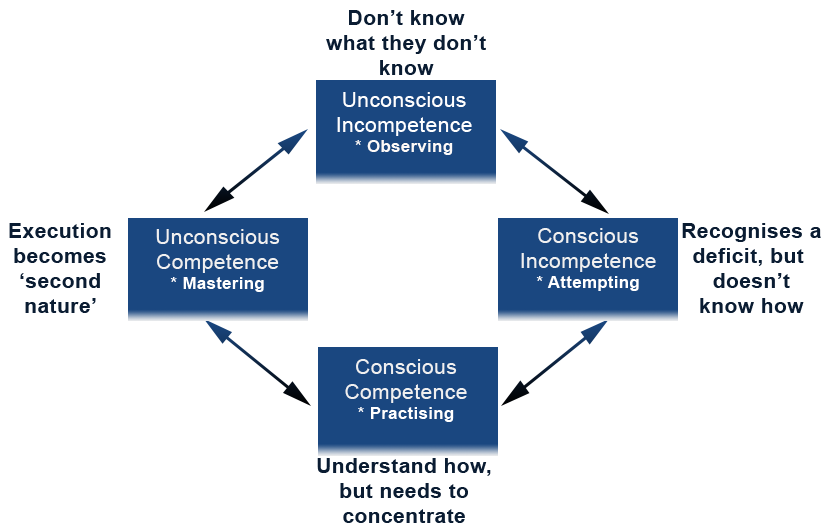
Unconscious Incompetence
The individual does not understand or know how to do something and does not necessarily recognize the deficit. They may deny the usefulness of their skill. The individual must recognize their own incompetence, and the value of a new skill, before moving to the next level. The length of time an individual spends on this stage depends on the strength of the stimulus to learn.
Conscious Incompetence
Though the individual does not understand or know how to do something, he or she does recognize the deficit, as well as the value of a new skill in addressing the deficit. The making of mistakes can be integral to the learning process at this stage.
Conscious Competence
The individual understands or knows how to do something. However, demonstrating the skill or knowledge requires concentration. It may be broken down into steps, and there is heavy conscious involvement in executing the new skill.
Unconscious Competence
The individual has had so much practice with a skill that it has become "second nature" and can be performed easily. As a result, the skill can be performed while executing another task. The individual may be able to teach it to others, depending upon how and when it was learned.
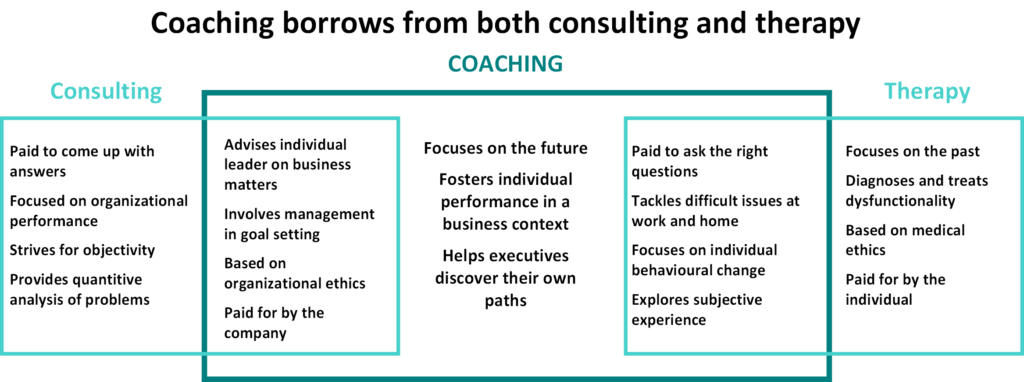
Where does a coach fit in?
© 2022 Adele Potgieter Business Coaching & Consulting